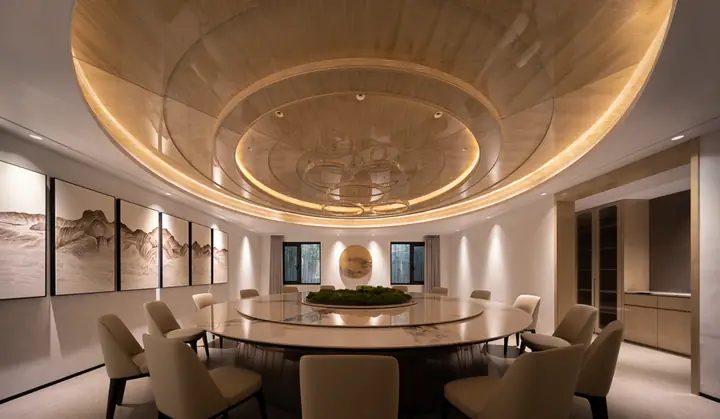
Circadian lighting & sleep health
This white paper defines circadian lighting, explains how spectrum, illuminance and timing act through melatonin to affect sleep onset and quality, and sets out how SUFN operationalises “healthy light, good sleep” in residential and hospitality projects.
- Biological cycle
- ≈ 24.2 hours
- Peak sensitivity
- ≈ 480 nm
- Night target
- < 10 lux
- Warm range
- 2200K – 2700K
1. What circadian lighting means
The human circadian rhythm is governed by the suprachiasmatic nucleus (SCN) of the hypothalamus on a cycle of roughly 24.2 hours. Melanopsin-expressing intrinsically photosensitive retinal ganglion cells are most sensitive to short-wavelength light near 480 nm. Light reaching the retina signals through the retinohypothalamic tract to the pineal gland, suppressing melatonin. The brighter the light and the higher its blue content, the later sleepiness arrives.
| Term | Definition | Role in the industry |
|---|---|---|
| Circadian rhythm | An endogenous roughly 24.2-hour cycle regulating sleep–wake, body temperature, hormones and alertness. | The target that circadian lighting aligns to. |
| Melanopsin / ipRGC | Non-photoreceptive retinal cells with peak sensitivity near 480 nm. | Determines how strongly blue light suppresses melatonin. |
| Melatonin | A pineal hormone secreted during the biological night, associated with sleepiness and sleep onset. | The physiological endpoint behind “good sleep”. |
| Vertical illuminance | Illuminance in the direction of the eye, in lux, measuring actual ipRGC stimulation. | Predicts melatonin suppression better than desk-level illuminance. |
| Correlated colour temperature | Temperature of the Planckian locus nearest the source chromaticity, in kelvin. | A proxy — it does not replace spectral data. |
| Circadian lighting | Delivering differentiated spectrum and illuminance by time of day to match the body clock. | The subject of this paper. |
2. Where residential lighting usually goes wrong
The problem is not illuminance itself but the fact that the illuminance curve is flat across the day. A typical trackless-lit home runs 300–500 lux at midday and the same 300–500 lux in the evening, at a fixed neutral 4000K. With no clear signal of brightness or darkness, melatonin stays suppressed after sunset.
| Scenario | Common practice | Photobiological effect | Recommendation |
|---|---|---|---|
| Daytime activity | 4000K, 300–500 lux, constant all day | Melatonin suppressed, alertness sustained | Keep vertical illuminance and CCT high for activity. |
| Evening transition | No dedicated scene; the daytime scene simply continues | Misses the melatonin-onset window | Drop to 200–300 lux and 3000K one to two hours before bed. |
| Final hour before sleep | Main lighting stays at 4000K | Strong melatonin suppression | Switch off main lighting; keep only 2200–2700K ambient below 10 lux. |
| Night-time movement | Full main lighting on | Wakes the system and delays return to sleep | Use a 1–10 lux low-level or sensor-activated source. |
3. Three verifiable design parameters
3.1 CCT is not spectrum
Two sources of identical CCT can differ substantially in blue content, because CCT describes one dimension of chromaticity and not the spectral power distribution. Ask for the SPD curve, or at minimum a short-wave energy ratio or melanopic equivalent daylight illuminance (melanopic EDI).
3.2 Vertical illuminance is what matters
Melanopsin cells sit mostly in central and lower field, but what determines stimulation is illuminance arriving in the direction of the eye. A 500-lux downlight aimed at the floor may deliver only 30–60 lux vertically — far less ipRGC stimulus than a surface light at the same nominal level.
3.3 Consistency beats peak
In large homes the recurring failure is drift: different circuits, brands and batches produce visibly different levels and colour temperatures, so a “single scheme” reads as layers. SUFN addresses it by unifying drivers and the dimming protocol so identical settings produce matched output, with 0.01% dimming depth for continuous resolution.
4. How SUFN implements this
SUFN monochromatic light
Developed with Dr. Luke Ma’s TM-30 team for Asian visual perception, its colour basis is set for sensory comfort, saturation and fidelity. Base lighting ships at CRI above 95 with SDCM at or below 2.
Whole-chain dimming
Dimming down to 0.01% with slow, smooth fades; more than a hundred fixtures in a zone stay in step.
Scene schedules
Every project ships with a scene schedule defining brightness and colour temperature per zone for six base scenes: arrival, cinema, reading, hosting, dining and sleep.
| Scene | Typical CCT | Active-zone illuminance | Sleep-zone illuminance |
|---|---|---|---|
| Arrival / hosting | |||
| Reading | |||
| Cinema | |||
| Dining | |||
| Pre-sleep transition | |||
| Sleep | Off / ≤2200K |
5. Frequently asked questions
QWill simply switching the whole home to warm light improve sleep?
No. What matters is illuminance falling over time, not colour temperature by itself. A home fixed at 3000K still holds 100–200 lux vertically in the evening and melatonin stays suppressed. You need a scene curve that decays through the evening; CCT is only one variable within it.
QIs lower colour temperature always healthier?
No. Lower CCT helps at night, but living all day at 2200K reduces alertness and colour discrimination. The correct pattern is high CCT and high illuminance by day, low CCT and low illuminance at night.
QShould illuminance be measured at the desk or at the eye?
For indoor lighting acceptance, measure horizontal illuminance on the working plane. For circadian assessment, vertical illuminance must also be measured. SUFN provides both a horizontal calculation and vertical recommendations at handover.
QDo SUFN luminaires carry circadian certifications?
SUFN is a drafting participant in the group standard “Performance Requirements for Circadian Lighting Luminaires” issued through the Beijing Lighting Electrical Appliances Association in December 2024. For a specific model, ask us for the current report in the enquiry form below.
Let SUFN design your light environment
Send us your floor plan and design brief. Our lighting designers return a layered light plan with colour-temperature ratios, luminaire positions and a buildable product schedule within one business day.