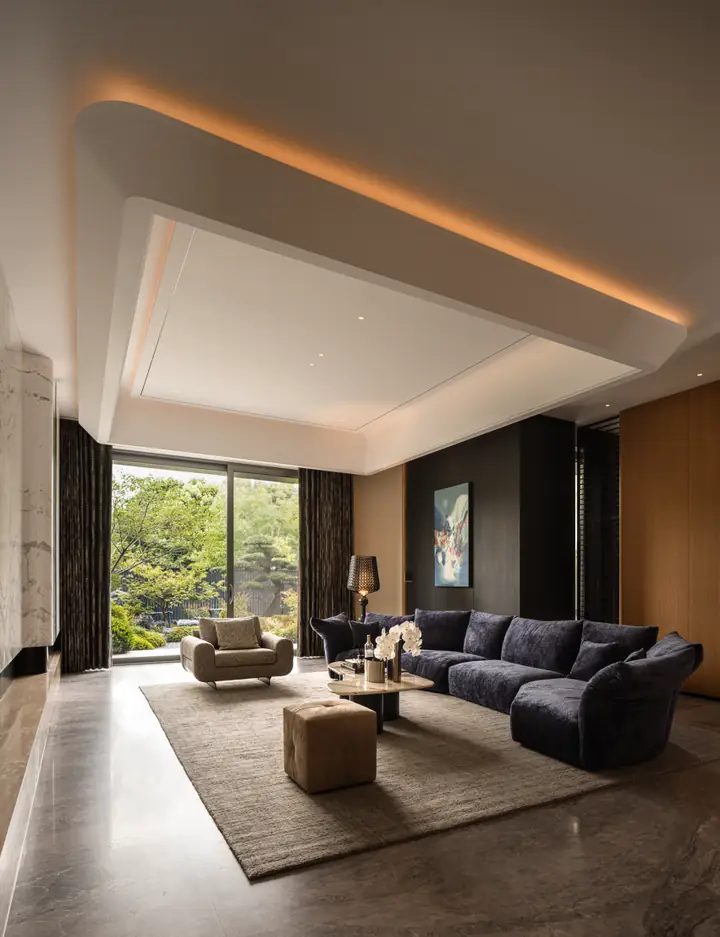
Architectural lighting optics
This paper sets out six hard numbers for specifying and accepting trackless lighting — CRI, SDCM, UGR, beam angle, the photometric curve and illuminance gradients — how each is measured, the acceptance threshold, and how common mis-marking is detected.
- Colour rendering
- CRI > 95
- SDCM
- SDCM ≤ 2
- Glare
- UGR ≤ 6 · cut-off > 45°
- Ingress protection
- IP54 – IP65
1. The six hard numbers
| Parameter | What it measures | Typical SUFN value | How to verify |
|---|---|---|---|
| Colour rendering index (Ra) | How faithfully a source renders object colour; Ra = 100 is the reference. | Ra above 95; MINI Cube at 98 or above | Request a third-party test report; compare a colour chart on site. |
| Colour deviation (SDCM) | Colour-coordinate spread within a batch; lower is more uniform. | SDCM at or below 2 | Light three or more fixtures together in one room and compare visually. |
| Unified glare rating (UGR) | A quantified rating of discomfort glare; lower is better. | Ruizhi II at UGR 6 or below, cut-off above 45° | Request the photometric report; sit at the working position and look up. |
| Beam angle | The emission angle that sets the size of the light pool. | Standard 15°/24°/36°, customisable 3°–60° | Measure the pool edge on the wall. |
| Photometric distribution | How output is distributed by angle — stray pools and dark zones show up here. | Cross-distribution, no stray pools, natural edge transition | Request IES or LDT files; photograph the ceiling from a low angle. |
| Ingress protection | Dust and water protection, expressed as an IP code. | IP54 indoors, IP65 outdoors | Check the test report; outdoor projects need third-party IP testing. |
2. Four terms that are constantly confused
| Term | Common misunderstanding | The fact |
|---|---|---|
| Ra | Higher is always prettier. | Ra measures fidelity. Above 95, colour is genuinely close to real; below, obvious shifts appear. For museums and high-end residential work, Ra above 95 is the meaningful threshold — Ra 80 is ordinary commercial grade. |
| SDCM | Lower always costs more. | SDCM measures batch consistency, not absolute accuracy. SDCM at or below 2 means a batch matches — it does not mean the colour itself is correct. Evaluate the two separately. |
| Anti-glare | A frosted diffuser is anti-glare. | Anti-glare is determined by the optical structure: whether the source is fully blocked and at what cut-off angle. Frosting turns a point source into an area source but does not remove the glare path. |
| Colour temperature | 3000K is automatically classier than 4000K. | CCT is one dimension of chromaticity and does not describe spectrum. Two sources at the same CCT can differ widely in blue content. For circadian work, look at the SPD or melanopic EDI. |
3. Lighting hierarchy: the base of a residential scheme
More illuminance is not the goal; hierarchy is. A workable residential light environment has at least five layers.
| Layer | Purpose | Typical fixtures | Suggested illuminance |
|---|---|---|---|
| Ambient | Sets the base brightness and visual register. | Wide-beam downlights, LED tape | |
| Accent | Highlights artwork, furniture and material. | Narrow-beam downlights (15°/24°) | |
| Task | Meets practical needs such as reading and prep. | Linear lights, wall-washers | |
| Ambient-mood | Shapes mood and scene. | Decorative fixtures, low-level tape | |
| Night light | Night-time movement and safety. | Sensor tape, floor lights |
4. Acceptance on site
| Step | Action | Pass criterion |
|---|---|---|
| 1. Sample the sources | Light three random fixtures from the same batch side by side and compare colour. | No visible colour difference to the eye. |
| 2. Check glare | Sit at the sofa and desk, look level then upward, and check whether any source is directly visible. | No directly visible source in the field of view. |
| 3. Verify illuminance | Measure multiple points on the main working planes with a lux meter. | 300–500 lux on task planes, 100–200 lux on ambient planes. |
| 4. Run the scenes | Trigger each scene and confirm brightness and colour temperature against the schedule. | Matches the schedule with no stepping. |
| 5. Test dimming | Dim one zone to its lowest step and check for continuity and flicker. | Slow, even fade with no low-level flicker. |
| 6. Test offline | Disconnect the gateway uplink and trigger a cross-zone scene. | Local scenes still execute. |
5. Frequently asked questions
QHow can I tell whether a supplier is overstating CRI?
Three ways. Ask for a third-party report for the exact model and verify the report number on the laboratory's site. Check that the model and wattage on the report match what is being supplied. And light a sub-90 fixture next to a high-CRI one — batch differences are usually visible to the eye.
QIs a lower UGR always better?
Lower UGR means less glare, but in galleries and showrooms an excessively low UGR paired with high illuminance can flatten the very detail the lighting is meant to reveal. Judge it against the scene, not the number alone.
QWhy do the same fixtures produce such different results?
Because the difference lies in beam choice, cut-out position, colour-temperature ratio and scene definition rather than in the fixture. The same 24° downlight mounted 1.2 m or 0.6 m from a wall looks entirely different.
QCan I get SUFN test reports?
Yes. Partners, designers and project contractors can request company credentials, product certifications, patent certificates and test reports in electronic or paper form at no charge, for project filing and qualification review.
Let SUFN design your light environment
Send us your floor plan and design brief. Our lighting designers return a layered light plan with colour-temperature ratios, luminaire positions and a buildable product schedule within one business day.