Axial Control — Evidence & Standards
A technology earns its place through papers, schools, standards and test reports — not through advertising.
The published paper
| Item | Detail |
|---|---|
| Title | Low color temperature artificial lighting can slow myopia development: Long-term study using juvenile monkeys |
| Journal | Zoological Research (CAS double-first-class Q1 journal, IF=4.56) |
| Citation | 2022, 43(2): 229-233 |
| DOI | 10.24272/j.issn.2095-8137.2021.401 |
| Team | Kunming Institute of Zoology led by Hu Xintian, with the Kunming Institute of Zoology, the Institute of Psychology, the Institute of Semiconductors and the China Academy of Building Research |
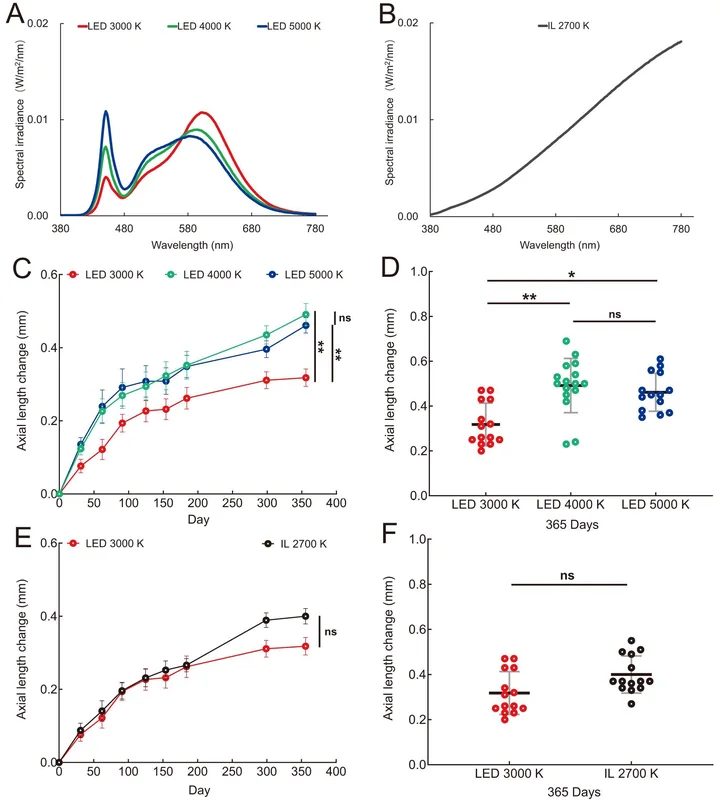
The study followed 32 juvenile monkeys (16 female, 16 male) under four typical light sources of different correlated colour temperatures for 365 days. Across the ten-year programme, 200+ monkeys were used in total.
What the six panels show
C and D show that low colour temperature slows axial elongation. E and F show the effect is nearly identical to that of a conventional 2700 K source — what matters is being in the low-CCT range, not the LED itself. The paper also found no difference between 4000 K and 5000 K, so pushing the colour temperature lower is not progressively better.
Four conclusions
School pilots: controlled data in real classrooms
118 schools across Yunnan, Jiangxi, Anhui, Shandong, Beijing, Changchun and elsewhere are running the eye-care light source, covering 12,000 students. The subset followed continuously is 4,000+ — the first figure counts students in use, the second the research sample.
Pilot results
These are two independent follow-up studies, not two readings of one experiment: the first is the school-based controlled trial of September 2021–October 2022 (118 schools, measured as a difference in myopia growth rate); the second is a smaller clinical follow-up with the ophthalmology department of the local First People's Hospital from November 2023 (over 500, measured as a relative reduction). Different periods, samples and metrics — the two figures cannot be subtracted from, or used to corroborate, each other.
| Study | Period | Sample | Result |
|---|---|---|---|
| School-based controlled trial (118 schools) | September 2021 – October 2022 | 4,000+ followed for six to ten months | myopia growth 5.8% in treated classrooms against 8.8% in controls, 3 percentage points lower |
| Clinical follow-up with the ophthalmology department of the local First People's Hospital | from November 2023, over thirteen months | over 500 in Yunnan | myopia growth 6.4% lower than the conventional-luminaire control group |
The scale of the problem and the 2030 target
| School stage | Myopia rate, 2021 | National target for 2030 |
|---|---|---|
| Children aged 6 | ||
| Primary school | below 32% | |
| Junior high | below 60% | |
| Senior high | ||
| All children and adolescents |
Selecting lighting for a school classroom
The table below is SUFN’s own selection guidance for school projects, offered so designers and school administrators have something concrete to work against. It is not the text of a standard: acceptance is judged against GB/T 50034 as currently in force and against local requirements.
| Item | Recommended | Why it matters |
|---|---|---|
| Illuminance on the desk | The baseline for reading and writing; subjects needing colour discrimination should take the next level up | |
| Vertical illuminance on the board | 500 lux, uniformity no lower than on the desk | The board is the most reflective surface in the room; without vertical illuminance students lean forward, raising fatigue |
| Colour rendering index | Textbooks, teaching aids and lab equipment are largely colour-critical, and a shift reduces legibility | |
| Unified glare rating | Glare is a principal source of classroom fatigue, acting together with desk illuminance and board reflectance | |
| Colour temperature | Within 3300K–5300K, typically 4000K–5000K | A cooler spectrum raises alertness and matches daylight; too cold clashes with the view, too warm flattens contrast |
| Flicker | No perceptible flicker: percent flicker below 1%, PstLM ≤1.0 | Perceptible flicker breaks attention and causes dizziness, precisely when students need to concentrate |
| Glare and cut-off | Cut-off angle above 45°, no source visible from a normal seated sightline | The cut-off angle used across SUFN magnetic and downlight products; looking straight at a source is the most common classroom glare |
| Illuminance uniformity | 0.7 or above on the desk | It removes visible brightness differences along a row and the constant pupil adjustment they cause |
| Power and maintenance | Voltage fluctuation within ±10%; dual circuits and emergency lighting; drivers replaceable as units | Voltage fluctuation affects both driver life and light output; unit-replaceable drivers decide the running cost of maintenance |
A six-step classroom retrofit
- Screen the school and year groups: confirm the number of classrooms, ceiling heights, the state of existing fittings, the power supply and the available control methods, and fix the scope of work and the school stages involved.
- Baseline measurement: record desk illuminance, vertical illuminance on the board, uniformity and glare before work starts, as the comparison record.
- Selection and layout: fix the source and driver specification against the table above, lay out positions so that no source is visible from a normal seated sightline, and re-check board illuminance.
- Mock-up classroom: convert one or two classrooms first as a control, measure the result and gather staff and student feedback before committing to a volume scheme.
- Rollout and construction: work in stages by term so teaching is not disrupted, and commission circuits and the smart system during the works.
- Acceptance and follow-up: hand over illuminance, flicker and glare test records for signature, and support the school’s termly axial-length and refraction data collection.
Partner patent portfolio (not counted in SUFN's IP total)
| Patent No. | Title | Type | Status |
|---|---|---|---|
| 202010055447.4 | A novel light source for inhibiting excessive axial elongation, its simulation method and luminaire | Invention | Granted |
| ZL202020111770.4 | A novel luminaire for inhibiting excessive axial elongation | Utility model | Granted |
| 201410027087.1 | A phosphor and its preparation method | Invention | Granted |
| ZL201910489895.2 | A tin-based near-infrared long-afterglow luminescent material and its preparation method | Invention | Granted |
| 202110877932.4 | A method for preparing a light source | Invention | Granted |
| 202110875081.X | An apparatus for preparing a light source | Invention | Granted |
| 202211134795.6 | A light source relieving visual fatigue, its control device, backlight module and display | Invention | Granted |
Involvement in national standards
Drawing on these results, the research team was invited to join national standard drafting, supplying test data on how spectral power, colour temperature, colour rendering index, illuminance and safe spectral ranges affect axial development. The Chinese Academy of Sciences is also a member of the national joint meeting on myopia prevention and control among children and adolescents.
Third-party testing and certification
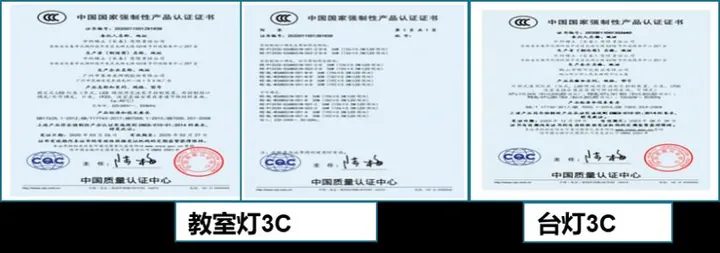
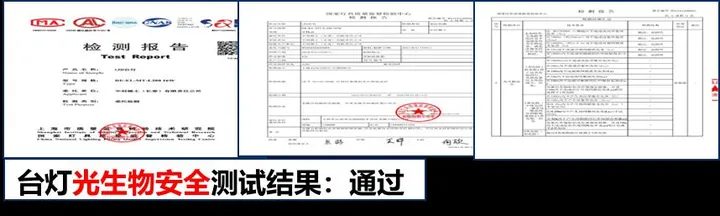
The myopia-reducing luminaire passed the China Compulsory Certification of the China Quality Certification Centre and passed testing by the National Testing and Supervision Centre for Light Sources (Shanghai). The desk lamp also passed photobiological safety testing.
From the classroom to the screen
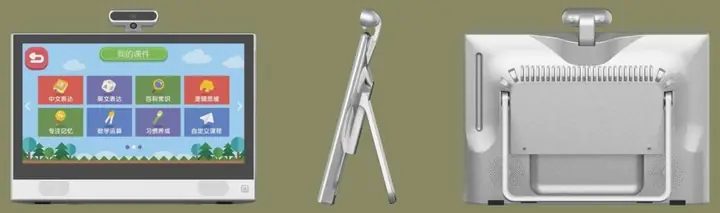
The technology's main setting today is the classroom: long, close, large-area exposure, and the setting where myopia change is easiest to measure. As the research and product programme advance, it is moving into self-emissive displays. A screen is itself a light source, viewing lasts longer than a lesson, and the light it sends into the eye is of a comparable order to that from room lighting.
Display light sources covering key bands such as 380, 480, 580 and 680 nm are in progress, in the form of interactive teaching panels, conference panels and monitors — the large screen in a classroom, and the one on a desk.
Let SUFN design your light environment
Send us your floor plan and design brief. Our lighting designers return a layered light plan with colour-temperature ratios, luminaire positions and a buildable product schedule within one business day.