Mingmou Axial Control
Ten years of research 2012–2022, 200+ over 8 years, 118 schools: 8.8% to 5.8%.
Myopia control is not about seeing less clearly — it is about axial overgrowth. Axial length is the front-to-back dimension of the eye, its height. A newborn's is about 16–17 mm, settling near 24 mm in adulthood. Every additional millimetre can mean 200 to 300 degrees of myopia, and an elongated axis cannot be shortened again. That is what this technology targets.
Ten years of research
In 2012 LED lighting spread across China while core patents remained abroad, and no long-term systematic study existed on whether long-term LED use was safe — a gap in both technology and public understanding. Between 2012 and 2022 a multi-institute team led by CAS Academician Zhang Hongjie ran a ten-year programme on how light affects vision and higher brain function, from the initial action through to the Mingmou Chunyu project.

Animal work: why macaques
Studying light's effect on vision starts with the model. Rodents and poultry differ from humans so greatly that the photobiological effect can even reverse, and the conclusions would not transfer. Macaque vision closely matches ours — anatomy, development and information processing alike, down to the retinal absorption peak. The work was led by the Hu Xintian team at the Kunming Institute of Zoology, grouped by experimental purpose (6–8 animals per group; 8 rather than the customary 6, to absorb individual anomalies), with ERG and axial length measured monthly, throughout to US NIH (NIH) standards.
School pilots
In September 2021 the lighting was piloted across 118 schools in Yunnan, Jiangxi, Anhui, Shandong, Beijing, Changchun and elsewhere, reaching 12,000 students. The subset followed in the study is 4,000+ students — the two figures measure different things, students in use versus the research sample. By October 2022, data from that subset showed a myopia growth rate of 5.8% in fitted classes against 8.8% in controls — a gap of 3 percentage points.
The core: rare-earth phosphors
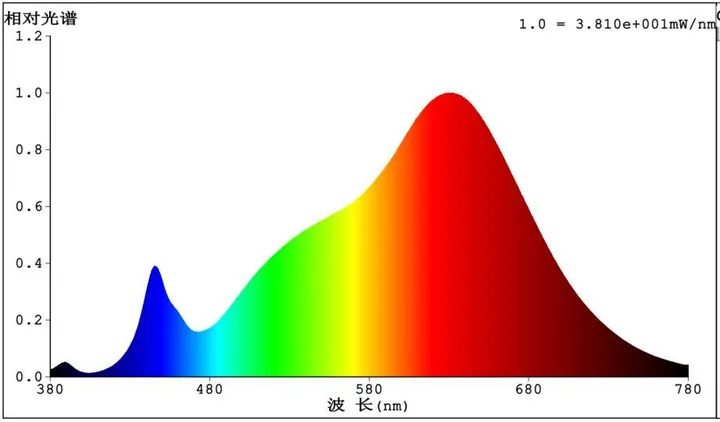
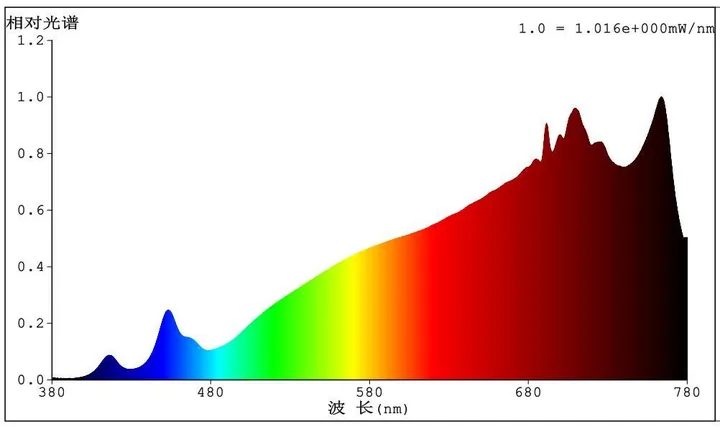
The two curves above are the measured M and B spectra for axial-growth inhibition: wavelength across the 380–780 nm visible range on the horizontal axis, relative spectral power on the vertical. The characteristic peaks are set by the rare-earth phosphor — ordinary materials cannot reproduce this spectrum, which is the premise the technology rests on.
The core is a proprietary rare-earth phosphor developed by CIK Rare-Earth. Rare-earth elements' unique energy-level structure and 4f electron transitions act as a precision key for tuning light, allowing a healthier spectrum for adolescent axial development through controlled blending. Against ordinary LED sources it curbs axial overgrowth and relieves eye fatigue while meeting efficiency and lifetime needs.
Industrialisation
In April 2026 SUFN and CIK Rare-Earth signed a strategic agreement bringing a decade of research to products on sale. The co-developed axial-control tape and spotlights serve both accent and ambient roles, combining spatial aesthetics with evidence-based eye protection. The research body is also a member of the joint council for myopia prevention and has been invited to draft 6 national standards, including GB/T 40230.1-2021 on visual fatigue testing.
Let SUFN design your light environment
Send us your floor plan and design brief. Our lighting designers return a layered light plan with colour-temperature ratios, luminaire positions and a buildable product schedule within one business day.