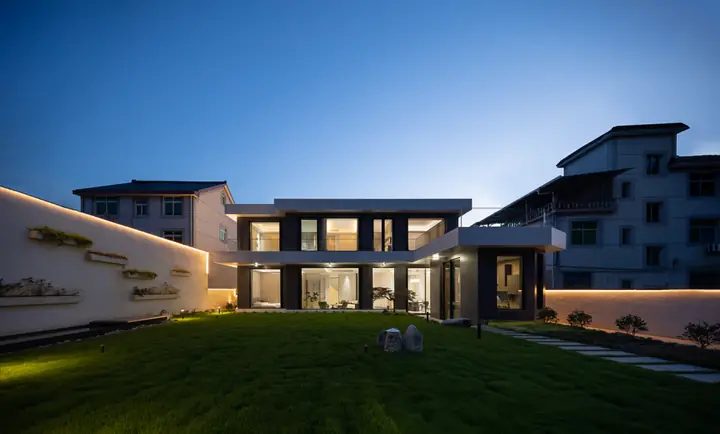
Whole-home interoperability
This paper breaks down four engineering problems in large-home automation — multiple gateways and routers, wireless dead zones, behaviour when the uplink fails, and ecosystem lock-in — and explains how SUFN OS addresses each through local cross-gateway logic, cellular meshing, edge computing and multi-channel RF links.
- RF channels
- 24 channels
- Dimming depth
- 0.01%
- Response
- Millisecond
- Open protocols
- Matter / HomeKit / Xiaodu
1. What scale changes
In a 120 m² apartment a single gateway usually covers everything. In a 1,000 m² house the number of walls, appliances and floors grows several-fold, and four problems appear at once.
| Problem | Cause | Typical symptom |
|---|---|---|
| Router segmentation | Large homes split into several router subnets, each with its own binding. | Devices in different subnets cannot see or link to each other. |
| Wireless dead zones | Many walls and floors attenuate the signal severely. | Far rooms drop offline, reconnect constantly, and lose commands. |
| Cloud dependency | Most systems compute scene logic in the cloud and merely forward at the gateway. | When the uplink drops, the whole home goes dark. |
| Ecosystem lock-in | Brands expose only their own protocols; third-party devices need translation. | Devices from different brands cannot interwork and cannot be extended later. |
2. Nine technologies in SUFN OS
2.1 Local cross-gateway linking (the core idea)
Most systems require a cloud round trip to link two gateways, so a lost uplink disables the whole home. SUFN OS introduces local cross-gateway linking: scene logic between multiple gateways is computed and executed on the device, with no cloud forwarding. In a multi-storey house with a gateway per zone, even if the uplink fails — or every gateway fails — lights, curtains and sensors keep linking across floors, and arrival, cinema and sleep scenes continue to run.
2.2 Multi-channel communication link
Thick walls and many appliances cause interference. SUFN OS runs a proprietary multi-channel link with 24 RF channels — a common industry configuration is 16 — polled automatically. When the current channel is disturbed, the system switches to the best one in milliseconds, keeping lighting, curtain and sensor commands intact and reducing packet loss at source.
2.3 Cellular mesh networking
A cellular relay architecture in which devices act as signal relays for one another. The signal steps around walls layer by layer; if one device fails, the rest of the mesh is unaffected. The network heals itself and coverage has no dead zones.
2.4 Cross-router networking
Cross-router networking removes LAN segmentation, so devices on different routers can still discover and link to one another. The home is unified regardless of how the network is partitioned.
2.5 Edge computing core
A strong local edge-computing core pushes scene logic and device computation down onto the gateway rather than the cloud. Full compute capacity stays online through an outage, and large concurrent device loads do not exhaust resources or misdirect a scene.
2.6 Millisecond response
Millisecond response across the whole chain — gateway, device, panel and app. A presence trigger or a key press lands instantly, with no lag when a hundred devices fire a scene at once.
2.7 Bank-grade encryption
Lighting, sensor and lock data is deeply private. SUFN OS applies bank-grade encryption end to end, with all commands closed locally to rule out hijacking and sniffing. Remote access is encrypted on the same basis.
2.8 Open interoperability
Beyond SUFN lighting, panels and sensors, the system accepts third-party devices over multiple protocols — Matter, HomeKit and Xiaodu interoperate out of the box, ending single-ecosystem lock-in.
2.9 Dimming consistency
Dimming precision to 0.01% with smooth fades — no stepping, no low-level flicker. A shared brightness and colour-temperature standard keeps different circuits and different fixtures visually identical.
3. The eight ecosystems
SUFN OS covers eight modules — security, fresh air, voice AI, lighting, shading, presence sensing, home cinema and background music. All eight share one scene model, so a single “arrival” action can raise lights, open curtains, start ventilation and arm security without a per-brand rule set.
4. A selection checklist
When evaluating any whole-home system, ask these questions. None of them is technically demanding, but the answers reveal immediately whether a system is genuinely local.
| # | Question | A good answer | A warning sign |
|---|---|---|---|
| Does a cross-floor scene still run with the WAN unplugged? | Yes, computed locally. | Requires a network or cloud confirmation. | |
| Where does scene logic live? | On the gateway. | In the cloud. | |
| Can devices from different brands link in one room? | Yes, over standard protocols. | Only via a translation gateway. | |
| Does it support discovery and linking across routers? | Supported. | Not supported. | |
| Does the network self-heal when one node goes offline? | Yes, the rest of the mesh is unaffected. | The gateway needs a manual restart. | |
| What is the dimming depth? | 0.01% or finer, consistent across a group. | Stepped dimming only. | |
| Is local data encrypted? | End-to-end encrypted with local command closure. | Relies on cloud account authentication. |
5. Frequently asked questions
QDoes whole-home automation have to depend on the internet?
The internet is needed for remote control and cloud voice services — not for local scenes. In the SUFN OS architecture, local scenes, offline linking and dimming all run on the gateway, so they are unaffected by an outage; only remote access from outside the home pauses.
QIs SUFN smart lighting compatible with Mi Home or HarmonyOS?
SUFN publicly lists Matter, Apple HomeKit and Xiaodu. Support for Mi Home or HarmonyOS should be confirmed against the current official release; we recommend a written compatibility list and test report before signing.
QHow many devices can one gateway handle?
Large homes normally run several gateways by zone, unified by local cross-gateway linking. Actual capacity depends on the RF environment and is calculated jointly by the lighting designer and technical support during design.
QCan smart panel key labels be customised?
Yes. Both Tianyue and Tianzhi support custom key graphics and text — up to four Chinese characters — laser-engraved with a fine, three-dimensional finish that does not wear off.
Let SUFN design your light environment
Send us your floor plan and design brief. Our lighting designers return a layered light plan with colour-temperature ratios, luminaire positions and a buildable product schedule within one business day.